
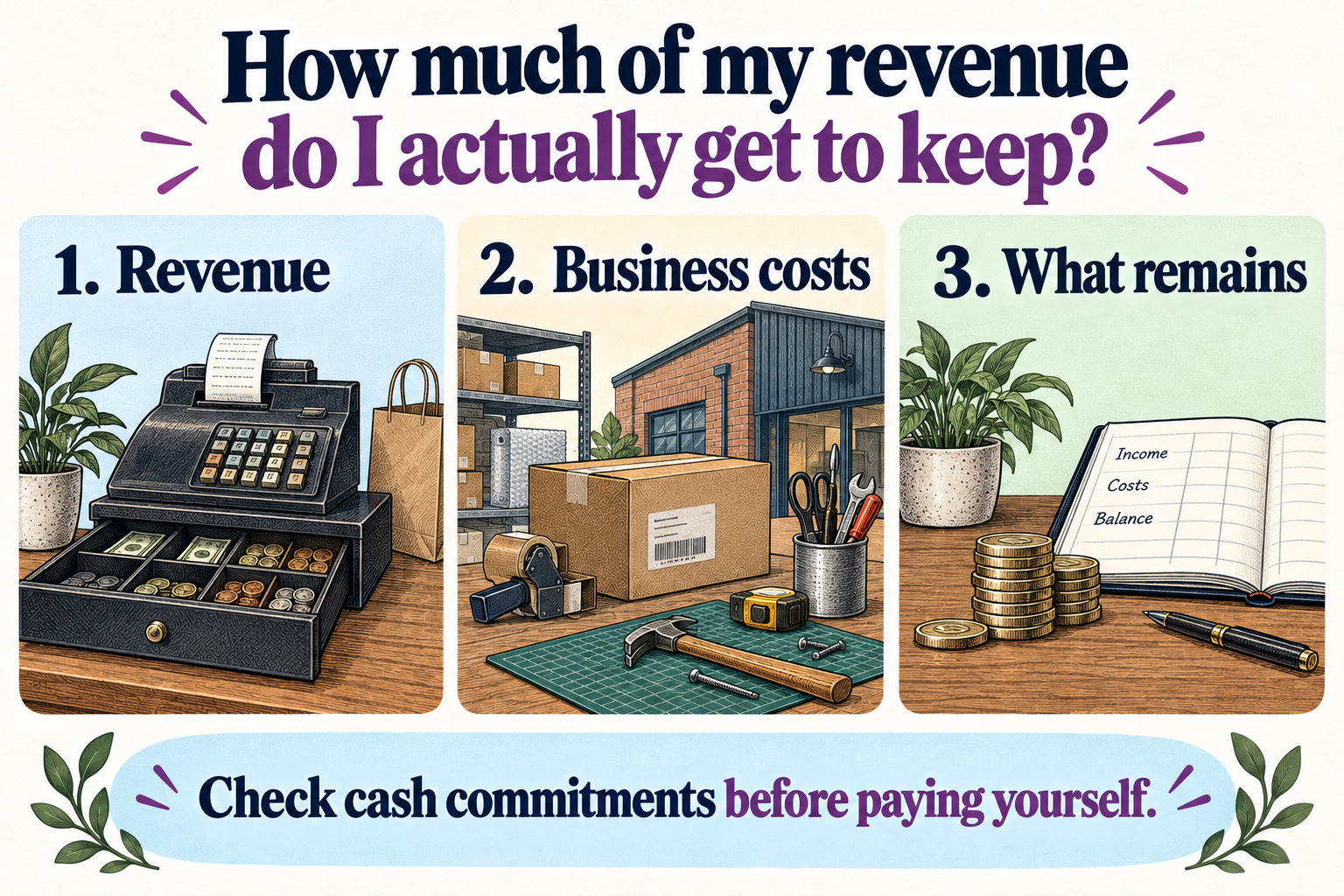
You worked for that revenue. You made the sale, delivered the work, answered the questions, and kept the business moving. It is reasonable to want to know how much of that effort becomes money you can use in your own life.
To answer, start with the period you want to understand. Last month is often easier to review than a busy week that is still unfolding. Put the revenue and expenses for that same period beside each other. Then look at the cash the business has today and what it still needs to pay.
What remains after the costs of running the business?
Imagine a business records $20,000 in monthly revenue. Delivering the work costs $8,000 in materials and outside help. Another $7,000 covers the other expenses entered for the month. That leaves $5,000 after those costs.
This is an invented example, and the result is only as complete as the expenses included. If the owner left out software subscriptions, insurance, or pay already recorded as an expense, the calculation needs correcting. If taxes have not been included, they still need to be considered.
Before deciding what you get to keep, check what has already been taken out of the number you are looking at. The amount left after delivering a job has a different meaning from the amount left after all the expenses of running the business.
What can the cash balance actually cover?
A profit report and a bank balance answer different questions. Revenue may include work for which payment has not arrived. Cash in the bank may include money received earlier that still needs to cover upcoming work.
Suppose the business in our example has $9,000 available today. It has $3,000 in unpaid bills, $1,000 still to set aside for taxes, and $1,000 in debt payments or planned purchases. The owner also wants to retain $2,000 for future operations. Those entries leave $2,000 in this cash worksheet.
That $2,000 is a planning result based on the commitments entered. It is not an automatic instruction to transfer it. A missing bill, an underestimated commitment, or a restriction on distributions can change the decision. The tax amount and operating reserve in this example are invented inputs, not recommended amounts or percentages.
Your own pay needs consistent treatment, too. If salary is already included in business expenses, do not subtract it again. An additional owner withdrawal is a separate decision. Your accountant can confirm how your business records each.
Work through your own numbers
The free worksheet below keeps the two calculations separate. First, enter revenue and expenses for one period. Second, enter today's business cash and the unpaid commitments and reserves that must come from it. Count each commitment once.
Open the free revenue and cash worksheet
No email address is required. Your figures stay in the page and are cleared when you refresh it. The worksheet shows the arithmetic; it does not calculate your tax bill or determine a permitted owner distribution.
If the remaining cash is lower than you expected, look at the entries before blaming the sales figure. Are customers still due to pay? Did delivering the work cost more than you allowed? Is the business carrying an expense you forgot to include? Each answer points to a different next step.
You can come away with a useful answer even if you are not ready to pay yourself more today: what the business earned after the costs entered, what cash is committed, and which number needs attention before the next transfer.
Financial-statement distinction: SEC guide to income statements and cash flow statements.